Garvey Vincent, Esquire
2025 Pegasus Scholar Report
The British historian Catharine Macaulay (1731–1791) was besotted
with the American colonies. It was Macaulay who wrote: “Of all the
various models of republics … it is only the democratic systems, rightly
balanced, which can secure the virtue, liberty, [security] and
happiness of society.” A case can be made that Macaulay helped to lay
the foundations for today’s special relationship” between the United
States and the United Kingdom—and by extension the Pegasus Scholarship
program. Given our system derived primarily from the English system, I
was particularly interested in how a separate government is structured,
how an advocate views and pursues justice in a different system and what
are the rights of the people in a monarchy.
With the sentiments of Macaulay, and these ideas firmly planted in my
mind, I set out for my six-week visit to the United Kingdom as a
Pegasus Scholar. This year, 2025, represented a milestone: it is the
thirty-fifth anniversary of the Pegasus Scholarship.
During the initial four-week period, Pegasus Scholars essentially
shared a schedule with scholars from the Temple Bar program. Pegasus and
Temple are parallel programs; thus, we often traveled as one, large
group. The first week was literally nonstop. It included but was not
limited to attending various briefings, observations, visits, tours,
lunches, dinners, and receptions. To highlight a few notable outings, we
toured the High Court of England and Wales, Old Bailey Criminal Court,
the Royal Court of Justice and the United Kingdom Supreme Court. The
first week also expanded our experiences of London, the UK system, and
its remarkable history. A typical outing would consist of a small group
gathering where we might visit a specific location such as an office,
conference room, or courthouse to engage in a conversation with whomever
was on our agenda. For example, The Rt. Hon The Baroness Carr of
Walton-on-the-hill The Lady chief Justice, Head of the Judiciary of
England and Wales, and the Rt. Hon Lord Reed of Allermuir, President of
the Supreme Court of the United Kingdom, and many many more. The
sessions often started with the individual whom we were meeting with
describing the roles they do and a little bit of history about their
role, job descriptions and oftentimes the buildings that were in. Then
it would transition into a question and answer period. During this
period, we scholars would pose inquiries to individuals for an allotted
amount of time and this would occur maybe two or three times per day
along with a scheduled lunch and maybe a tour or two. In addition,
during this first week we ended nearly each night with a dinner and
evening reception with Pegasus alumni and their families, as well as
other high ranking members of either the American and well the British
Inn of court.
The following two weeks saw a change in our agenda. Our large group
was disbanded and individually we were invited to spend time in what is
referred to as “chambers” which are collections of individual barristers
which act in many ways like a small law firm. Whereas the first week
can be characterized as a broad introduction, the next two weeks were
distilled down to a more hands-on, day-to-day approach. We learned,
first-hand, the diurnal routines and rhythms of the lives of barristers.
During this period, we observed courtroom proceedings and case
discussions, formulated inquiries, helped out with small matters, and
provided American insights to given situations. In one particular
highlight of this two-week period, Pegasus Scholar alumnus, John Burke,
took us to Luton where we observed a man charged with a speeding
violation vigorously arguing with the judge. While the man did make some
persuasive arguments he ultimately was unsuccessful in his attempt to
shake his civil charges.
 The
final week of our time in London, the six of us regrouped and we spent
the week with the head of the UK’s legal system: the United Kingdom’s
Supreme Court (UKSC) and each of us was assigned a Justice with whom we
would be with. As the UK highest court, it also serves as the final
court of appeal for many former British territories and often the final
word for many global disputes. This is because in many international
contracts, parties voluntarily choose to be governed by British laws. As
the final court for so many disputes across the world, hearing their
perspective on legal rights and governance was fascinating.
The
final week of our time in London, the six of us regrouped and we spent
the week with the head of the UK’s legal system: the United Kingdom’s
Supreme Court (UKSC) and each of us was assigned a Justice with whom we
would be with. As the UK highest court, it also serves as the final
court of appeal for many former British territories and often the final
word for many global disputes. This is because in many international
contracts, parties voluntarily choose to be governed by British laws. As
the final court for so many disputes across the world, hearing their
perspective on legal rights and governance was fascinating.
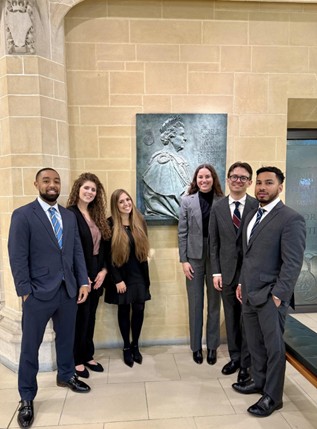
What made this week so extraordinary was the access that we were
granted; we were able to develop relations with their Judicial
Assistants (JA), similar to that of a clerk in the US. We were also able
to connect with the Justices on a personal level. When I first applied
to law school, I never imagined myself having the privilege dining with
Supreme Court Justices. I want to give a huge shout out to my assigned
Justice, Lady Rose of Colmworth as the conversations that we had
regarding the European Convention of Human Rights was truly a once in a
lifetime experience.
 At
the end of the fourth week, the Temple Bar Scholarship program ended
while the Pegasus program continued for the remaining two weeks into the
Hague, then Manchester, then up to Edinburgh and our program ended in
Belfast. A highlight of the Hague was being able to tour the
International Criminal Court (ICC) and also learn about the history of
the Netherlands via numerous tours and museums in the country. While in
Manchester, we were shown a fantastic time by Pegasus Scholar alumnus
Liam Kelly. Manchester to me felt like a small alternative to London,
similar to what Oakland is to San Francisco or what New Jersey is to New
York City. In Manchester, we were also fortunate enough to observe a
court proceeding from the bench after spending the day with his
Honorable Judge Nigel Bird. Ireland and Scotland were full of amazing
buildings, legal libraries and sights to see. The castles in Scotland
were phenomenal as many were built nearly 1000 years ago.
At
the end of the fourth week, the Temple Bar Scholarship program ended
while the Pegasus program continued for the remaining two weeks into the
Hague, then Manchester, then up to Edinburgh and our program ended in
Belfast. A highlight of the Hague was being able to tour the
International Criminal Court (ICC) and also learn about the history of
the Netherlands via numerous tours and museums in the country. While in
Manchester, we were shown a fantastic time by Pegasus Scholar alumnus
Liam Kelly. Manchester to me felt like a small alternative to London,
similar to what Oakland is to San Francisco or what New Jersey is to New
York City. In Manchester, we were also fortunate enough to observe a
court proceeding from the bench after spending the day with his
Honorable Judge Nigel Bird. Ireland and Scotland were full of amazing
buildings, legal libraries and sights to see. The castles in Scotland
were phenomenal as many were built nearly 1000 years ago.
Our six weeks in the UK provided a rich tapestry of unforgettable
experiences and people. These travels provide invaluable opportunities
for reflection and learning. To that end, the section below will
illustrate how the Pegasus Scholarship Program has impacted my views of
the law and the Inns of Court.
UK Court Traditions & Customs/Bifurcated Bar/Barristers and Solicitors
One of the more striking legal distinctions is how the UK splits the
profession by having one set of attorneys interface with clients while
having another set argue in court. The client facing attorneys are
solicitors while the court advocates are known as barristers. The United
States employs a different approach where once you become a member of
the bar, you can do pretty much anything any other attorney can do and
you’re typically restricted only by your experience level. While some
places within the U.S. will have a system that resembles the U.K.
bifurcated bar; for example a law firm that has attorneys who specialize
in trial work and others who never see a courtroom. Attorneys who come
in and try cases when they reach a certain point are as close to the
barrister/solicitors split as we have here in the US.
At first it didn't make sense to me why split the profession into two
but as our program went on I began to understand how it can be
effective. I had a U.K. attorney explain to me that "If I'm your
attorney and we’re constantly in and out of court, I'm not doing a very
good job.” When framed this way, it makes more sense; your lawyers’ job
is in some respects to keep the client out of court but when the need
for courtroom advocacy arises, you just go hire an expert in court
advocacy. Interestingly, the barristers are all self-employed and are
contacted by solicitors whenever a solicitor has a matter that needs to
be handled in court.
 One
thing I can appreciate about the British is that they love their
traditions. For example, the wig and the rope appear at times silly at
times to us in the US but they have real meaning in the UK courtroom.
Though not every court requires the wig, the ones that do take it very
seriously. Technically, the judge cannot “hear” you if you do not have
your wig and rope on properly. Now you might think the wig has no
practical application but it in fact can be useful for providing
anonymity to attorneys in certain situations. For example, a barrister
told us a story of how when he was a younger barrister he was
prosecuting a gentleman whose family was in the court room during the
prosecution. Once the proceeding concluded, the barrister ends up
getting in the same uber as the family of the individual whom he just
prosecuted. However, the family did not recognize him without the wig
and robe, which bypassed an awkward car ride. And having seen barristers
with and without the wig, it is shocking how different one looks
without it.
One
thing I can appreciate about the British is that they love their
traditions. For example, the wig and the rope appear at times silly at
times to us in the US but they have real meaning in the UK courtroom.
Though not every court requires the wig, the ones that do take it very
seriously. Technically, the judge cannot “hear” you if you do not have
your wig and rope on properly. Now you might think the wig has no
practical application but it in fact can be useful for providing
anonymity to attorneys in certain situations. For example, a barrister
told us a story of how when he was a younger barrister he was
prosecuting a gentleman whose family was in the court room during the
prosecution. Once the proceeding concluded, the barrister ends up
getting in the same uber as the family of the individual whom he just
prosecuted. However, the family did not recognize him without the wig
and robe, which bypassed an awkward car ride. And having seen barristers
with and without the wig, it is shocking how different one looks
without it.
While in the courtroom, the styles of advocacy between the UK and US
are quite different. For example, a phrase that barristers use in court
frequently is "I'm grateful.” It is incredibly common during the court
proceeding to hear both barristers utter the phrase in any particular
situation - when requesting a recess, when first beginning to speak,
after the judge hands down a ruling, are all instances where a proper
response consists of “I’m grateful.” Additionally, we learned how
barristers often refer to the opposing counsel as “my learned friend” or
“my friend” both in and out of court. I’ve come to appreciate how small
exchanges like this create a more friendly as less adverse environment
and helps to foster relationships between the barristers. While in the
US, we can be a little more adversarial to opposing counsel, it was
quite interesting to see advocacy executed differently.
 Furthermore,
on the point of congeniality, a rare but not uncommon practice in some
rather large cases is that of a case dinner. Where both parties of a
case take the judge out to a restaurant as a thank you to the judge once
the proceedings have ended. The dinner is to be set up by the youngest
barrister on the case and typically paid for by the more senior
barristers. A barrister shared a story with me of how he once set up one
of these case dinners early in his career and the issue in the case
concerned tariffs on a particular bottle of wine. The barrister
proceeded to order that exact bottle of wine for everyone at the dinner
and all enjoyed a laugh about it subsequently. Anecdotes like this one
show how different yet similar our systems are. While a case dinner such
as this could never happen in the US for a variety of reasons, I see it
as a reminder of the underlying human element of the law, and that
acknowledgment can manifest itself in unexpected ways.
Furthermore,
on the point of congeniality, a rare but not uncommon practice in some
rather large cases is that of a case dinner. Where both parties of a
case take the judge out to a restaurant as a thank you to the judge once
the proceedings have ended. The dinner is to be set up by the youngest
barrister on the case and typically paid for by the more senior
barristers. A barrister shared a story with me of how he once set up one
of these case dinners early in his career and the issue in the case
concerned tariffs on a particular bottle of wine. The barrister
proceeded to order that exact bottle of wine for everyone at the dinner
and all enjoyed a laugh about it subsequently. Anecdotes like this one
show how different yet similar our systems are. While a case dinner such
as this could never happen in the US for a variety of reasons, I see it
as a reminder of the underlying human element of the law, and that
acknowledgment can manifest itself in unexpected ways.
The Four Inns of Court in England and Wales
In the United States, one gets admitted to the Bar of the selected
state. Every attorney remembers that feeling; logging on to the state
bar’s website (or waiting for an envelope in the mail) to check to see
if they passed the bar exam and can now become a practicing attorney in
said state. Interestingly, that's somewhat of an uniquely American
experience to become an attorney. Barristers in the UK go through more
of a pupillage program for about a year before being able to practice.
Additionally, while the American Inns of court are completely voluntary
to join, all barristers are a part of an inn, which are essentially
professional associations of barristers. Previous comparisons have
included the houses in Harry Potter, or any groupings of fraternities
and sororities, but I feel an equally valid comparison would be the
major conferences in college athletics. The four major inns are: Inner
temple, middle temple, Grays inn and Lincoln's Inn.
Walking though the Inns feels almost like that of a college campus.
But one thing that is immediately striking when walking though the Inns’
is the impressive architecture, peaceful gardens and extensive
libraries. While each inn brings its own unique flavor, it is clear that
they all share a common goal of upholding the standards of the
profession. The formal meals, practice debates, and talks that take
place at each respective inn demonstrate a lasting dedication to
developing legal experts. I'm grateful for the invitations from each Inn
to go to talks, meals, and meet-ups, connect with members and students,
and really get to know their history and goals for the future.
Political Structure & History
The US prides itself on our doctrine of separation of powers and the
notion that a system that contains checks and balances on itself
prevents the accumulation of too much power in any one area of
government. The idea being that in any government, there will always be
an ambitious individual seeking to increase their power but the separate
branches ensure stability as any power increase by one branch reduces
power in another. Theoretically, ensuring a stable system as no branch
would willingly give up power - thus ambition tapers ambition.
However, the UK does not make the same attempt at a “power balance”
and instead rests the majority of power with Parliament (the equivalent
of congress in the US) For example, with few exceptions, the UK
judiciary cannot strike down legislation, rather the court can only
provide suggestions to the legislature on how to better improve policy.
However, it is much easier for parliament to pass legislation than it is
for congress and they don’t have to worry about overstepping into the
authority of the executive branch or about their legislation being
unconstitutional. As it was described to me by a UK attorney - “an act
of parliament cannot be unconstitutional.” The implication being that if
parliament enacts it, it is legal and the court really isn't in a
position to strike it down absent a few narrow exceptions. This allows a
lot more fluidity in the system. US law is meant to be a slow moving
vehicle, it is based on precedent and only after lengthy debate,
exchange of ideas, and cross examination of the other side, do we move
in any one direction. And while this can often result in stalemates and
policy that is slow to catch up, it is meant to provide stability and
predictability. The UK on the other hand seems to be more fluid in its
laws and Parliament has the ability to change laws much more rapidly
than the US.
Something that became clear to me while learning about English law is
that there are many ways to achieve justice and our nations simply go
about that goal in different ways. In the US, our supreme law of the
land is the US Constitution. That is the document where nearly all of
our laws stem from in some way. In the UK, the foundational document is
the Magna Carta. Interestingly, of the 63 total original clauses in the
Magna Carta, clause 39 and 40 seem relatively insignificant in the
larger scheme of things, however these two clauses set out to limit the
rights of the King. A revolutionary concept at the time in Europe, and
these two clauses provide a starting point for our own US Constitution
as those clauses are considered by some to be the genesis of due
process. While their system began limiting the previous rights of a
king, our system never had a king to begin with, thus our foundational
document began with asserting rights of the individual. Seems almost
like a top down vs a bottom up approach to achieving justice.
Cultural Immersion British Life & Society
Outside of the law, London and the other places we visited had so
much to enjoy. A personal highlight was on my last day in London, I was
able to visit both the Marcus Garvey Library, as well as Marcus Garvey
Park. Both visits were of particular importance as that is whom I was
named after.
 Additionally,
a highpoint was attending the theater at London’s West End. Two plays
that resonated with me were Hamilton and Witness for the Prosecution. As
an American attorney these plays represented both the historical and
current interplay between the US and UK. Hamilton’s focus is US
independence from the UK and how a new nation constructs a new legal
system from the foundations of English law. Conversely, Witness for the
Prosecution critiques our shared belief in the judicial system’s ability
to pursue justice. Both plays examine methods for improving the
judicial system. Hamilton depicts the necessity of adapting an existing
legal system to better fit a new context. Witness for the Prosecution
illustrates the roles that gender and ethnicity play in judicial
outcomes.
Additionally,
a highpoint was attending the theater at London’s West End. Two plays
that resonated with me were Hamilton and Witness for the Prosecution. As
an American attorney these plays represented both the historical and
current interplay between the US and UK. Hamilton’s focus is US
independence from the UK and how a new nation constructs a new legal
system from the foundations of English law. Conversely, Witness for the
Prosecution critiques our shared belief in the judicial system’s ability
to pursue justice. Both plays examine methods for improving the
judicial system. Hamilton depicts the necessity of adapting an existing
legal system to better fit a new context. Witness for the Prosecution
illustrates the roles that gender and ethnicity play in judicial
outcomes.
The phrase “life-changing” is used a lot, however I want to make it
very clear that this experience as a Pegasus Scholar was life-changing
in the most genuine sense of the words. At times, I really did feel like
an English barrister; grabbing a cup of coffee at a tube station and
going to court in the morning, fish and chips for lunch, conversing
about cases at chambers in the afternoon, then meeting up with
colleagues at the pub in the evening. It was interesting to see
firsthand where the US’s legal system began and where we decided to
break from the UK’s system. These observations and insights into the
UK’s legal system served as a reminder of why I chose to pursue law in
the first place. There are many ways to go about the pursuit of justice,
and exploring how other countries pursue justice offers a fresh
perspective on and an appreciation for my own country's methods and ways
it can be improved.
Message to Future Applicants
 To
any young attorney in the U.S. considering applying to this program,
let this be a sign to start putting together your application. The
program really is what you and your co-scholar make of it. And to that
end, here are four attributes that I think make for a successful Pegasus
Scholar; gritty, hard-working, curious and fun. Having grit is
necessary because there is so much opportunity in the six weeks to make
connections and experience everything the UK has to offer. It’s
important to commit yourself to the program and to go after the
experiences you seek to acquire. Hard work is also a requirement because
the application process is long and arduous; there will be long days
and there is just no time to be lackadaisical. Curiosity is extremely
important as well because you will be speaking and engaging with people
from a different culture and learning about a new legal system. If you
are not genuinely curious about what's going on in other countries or
why their legal system is set up the way it is or why their traditions
exist you simply won't get everything you can out of the program.
Importantly, being fun is essential. You’ll be attending dinner parties
and networking receptions, meeting many new individuals and exploring
parts of the world that you may have never seen before and exploring the
world with your co-scholar. Making friends with barristers you meet
randomly in court hearings or in chambers can lead to incredible
adventures and memorable relationships. If you feel you embody these
attributes, I strongly encourage you to apply to the Pegasus Program!
To
any young attorney in the U.S. considering applying to this program,
let this be a sign to start putting together your application. The
program really is what you and your co-scholar make of it. And to that
end, here are four attributes that I think make for a successful Pegasus
Scholar; gritty, hard-working, curious and fun. Having grit is
necessary because there is so much opportunity in the six weeks to make
connections and experience everything the UK has to offer. It’s
important to commit yourself to the program and to go after the
experiences you seek to acquire. Hard work is also a requirement because
the application process is long and arduous; there will be long days
and there is just no time to be lackadaisical. Curiosity is extremely
important as well because you will be speaking and engaging with people
from a different culture and learning about a new legal system. If you
are not genuinely curious about what's going on in other countries or
why their legal system is set up the way it is or why their traditions
exist you simply won't get everything you can out of the program.
Importantly, being fun is essential. You’ll be attending dinner parties
and networking receptions, meeting many new individuals and exploring
parts of the world that you may have never seen before and exploring the
world with your co-scholar. Making friends with barristers you meet
randomly in court hearings or in chambers can lead to incredible
adventures and memorable relationships. If you feel you embody these
attributes, I strongly encourage you to apply to the Pegasus Program!
Conclusion
One final, important point warrants mentioning: I am appreciative and
grateful. First and foremost, to all the individuals who worked
tirelessly to make this happen. I want to give thanks to my co-scholar,
Nancy Braman, who not only was an incredible planner and was on top of
the schedule the entire time, but also an amazing partner for this trip.
A big shoutout to the Temple Bar Scholars and the Pegasus Scholars from
other countries (Australia, India, Malaysia and New Zealand.) I also
would like to extend my deepest gratitude to those who helped me along
the way, Retired California Supreme Court Justice Martin Jenkins, Cathy
Ongiri, Maria Bee, and Richard Levenstein - without your support I would
have never had this incredible opportunity. Significantly, Cindy Dennis
deserves a special recognition. Her guidance and assistance proved to
be invaluable throughout this entire process.
The Pegasus Scholarship Program has provided me with the
extraordinary opportunity to participate in and experience in real time
the “special relationship” between the United States and the United
Kingdom. The enduring foundations and lasting principles of our
representative governments include but are not limited to our shared
legal traditions, language, security, and technological collaborations.
Thus, the “special relationship” between our countries will persist well
into the future. And, if by chance, Catharine Macaulay were able to
witness today’s remarkably close relationship between the United States
and the United Kingdom, or more particularly, the Pegasus Program, she
would be, in a word, amazed.